Is SEO dead? With AI answers at the top of Google and more people asking ChatGPT for recommendations, it’s a fair question for any business owner who pays for marketing. The short answer is no. SEO isn’t dead, but the way people search has changed, and the businesses that adapt are the ones still getting found.
In this guide, we’ll look at what the latest data from Google, Pew Research Center, Ahrefs, and BrightLocal actually shows. Then we’ll cover which SEO tactics have stopped working and what to focus on instead.
The Short Answer: SEO Isn’t Dead, It’s Evolving
Is SEO dead in 2026? No. Google search is still growing, and AI tools still rely on websites for their answers. What has changed is how results look and how often people click.
Search engine optimization has always meant helping the right people find your business when they search. That goal hasn’t changed. The difference in 2026 is that you need to be visible in more places: the regular results, Google’s AI Overviews, Google Maps, and AI assistants like ChatGPT.
Why So Many People Are Asking “Is SEO Dead?”
The question keeps coming up because search results look very different than they did a few years ago. Google now shows AI-written summaries above many results, and those summaries answer some questions before anyone clicks.
A Pew Research Center study found that Google users clicked a traditional result on 8% of visits when an AI summary appeared, compared with 15% of visits when there was no summary. Only 1% of visits included a click on a link inside the summary itself.
Numbers like these make headlines. However, they describe fewer clicks on certain searches, not the end of search.
Is SEO Dead? What the 2026 Numbers Say
If you want to know whether SEO is dead, the numbers are the best place to look. They show that people are searching more than ever. They’re simply using more tools to do it.
Google Search Is Still Growing
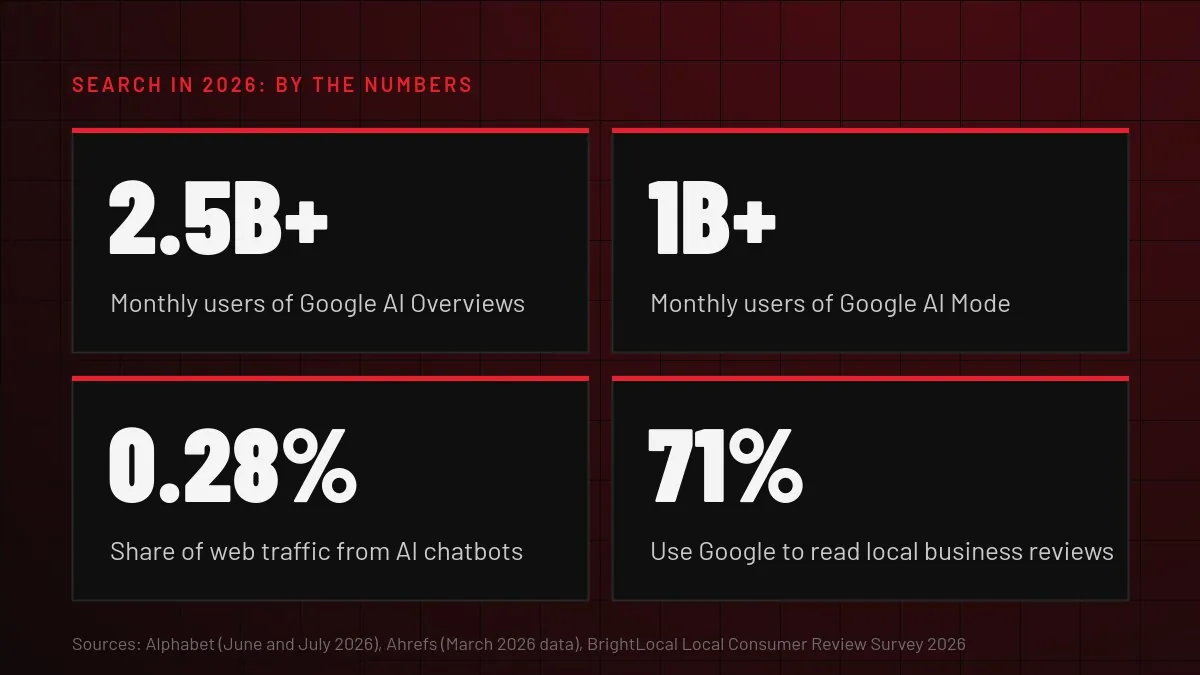
Google says search activity keeps hitting new highs. In its June 2026 investor presentation, Alphabet reported that search queries reached an all-time high and that AI Overviews now reach more than 2.5 billion users every month.
On its Q2 2026 earnings call, Google reported 17% revenue growth in Search and said AI Mode has passed 1 billion monthly users. CEO Sundar Pichai said AI Mode is driving “an incremental increase in Search queries overall” and that Google is “now sending billions of clicks to websites every week through AI features in Search.”
AI Chatbots Still Send a Small Share of Traffic
AI assistants are growing fast, but they don’t send nearly as many visitors as Google. According to Ahrefs data from March 2026, AI chatbots accounted for just 0.28% of total web traffic across 74,752 websites. That was roughly 1% of the visits Google sent to the same sites.
Local Customers Still Start on Google
For local businesses, Google remains the main place customers check before they call. BrightLocal’s Local Consumer Review Survey 2026 found that 97% of consumers read reviews for local businesses, and 71% use Google to read those reviews.
The same survey also shows where search is heading. 45% of consumers now use ChatGPT or other AI tools for local recommendations, up from just 6% a year earlier. That’s why modern SEO has to cover AI search as well as Google.
If SEO Isn’t Dead, What Changed?
Three big shifts explain why SEO feels different in 2026.
Fewer Clicks on Simple Questions
Quick facts, definitions, and simple how-to questions are often answered right on the results page. As a result, blog posts that only repeat basic information get fewer visits than they used to.
AI Pulls From More Sources
AI Overviews don’t only cite the top-ranking pages. In a 2026 Ahrefs study of 863,000 keywords, 38% of AI Overview citations came from pages ranking in Google’s top 10, compared with 76% in its 2025 study. Ahrefs notes its detection methods improved between studies, so the drop isn’t a perfect comparison. Still, it shows that clear, well-organized content can be cited even when it isn’t ranking first.
Reviews and Your Business Profile Matter More
For local searches, your Google Business Profile, reviews, and photos often show up before your website does. Because AI tools also draw on reviews and local listings, a strong reputation helps you in every type of search.
What’s Dead: SEO Tactics That No Longer Work
When people say SEO is dead, they’re usually thinking of these old-school tactics. They really are dead, and they can hurt your rankings today.
- Keyword stuffing. Repeating the same phrase over and over makes content hard to read and does not help you rank.
- Thin, copy-paste pages. Dozens of near-identical pages with no real information rarely rank or get cited.
- Buying cheap links. Spammy backlinks can do more harm than good.
- Writing for robots. Content written only for search engines, rather than for people, struggles in both Google and AI answers.
- Chasing traffic instead of leads. Ranking for terms that never bring in customers wastes time and money.
SEO Isn’t Dead: How to Do SEO That Works in 2026
Modern SEO is about being the clearest, most trustworthy answer for your customers wherever they search. Here’s where to focus.
- Answer real customer questions clearly. Start each section with a direct answer, then add the details. This format works for readers, Google, and AI tools.
- Optimize your Google Business Profile. Keep your hours, services, and photos current, and ask happy customers for reviews. Our local SEO services cover this step by step.
- Keep your content fresh. Update important pages and posts regularly, and show the date so readers know the information is current.
- Make your website fast and mobile friendly. Most local searches happen on phones, so a slow or clunky site costs you calls. Learn more about our mobile-first web design.
- Track leads, not just rankings. Measure calls, form fills, and booked jobs so you know what SEO is actually earning you.
- Pair SEO with paid ads when you need speed. SEO builds long-term visibility, while Google Ads management can bring in leads while your rankings grow.
Is SEO Still Worth It for Small Businesses?
Yes. If you’ve been wondering “is SEO dead for my business,” the answer is no. For most local businesses, SEO is still one of the best long-term investments in marketing. Paid ads stop the moment you stop paying, but strong rankings, reviews, and helpful content keep working for you month after month.
That’s especially true for service businesses competing in a local market. If you’re in Western Pennsylvania, our guide to marketing for Pittsburgh businesses shows how we approach local search across the region.
Frequently Asked Questions
Will AI replace SEO?
No. AI tools still need websites to learn from and to cite. SEO is expanding to include AI search, so the same work that helps you rank in Google also helps you show up in AI answers.
Is SEO dead for small businesses?
No. Local customers still use Google to find, compare, and review businesses near them. A well-optimized website and Google Business Profile remain two of the most valuable tools a small business can have.
How long does SEO take to work?
For most businesses, SEO is a 3 to 6 month build. Early improvements often show up sooner in Google Maps and in longer, more specific searches. See our SEO services for what that process looks like.
The Bottom Line: SEO Is Far From Dead
So, is SEO dead? Not even close. Search is bigger than ever, but it now happens across Google’s regular results, AI Overviews, Google Maps, and AI assistants. The businesses that win are the ones that answer customer questions clearly, keep their information fresh, and build a reputation customers can trust.
Want to know where your business stands in local search? Get a free quote and we’ll show you what’s working, what isn’t, and what to do next.